

Today, to know on demand is how most of us come to possess. If you know where to find plums you go there, and not to all the other places where plums may be. A notification pops up from Tesco; Clubcard Price: Punnet of plums 99p. So the offer is saved and within a day it’s in a trolley. Did you even want plums to begin with? Probably not. But one less decision and a 19p saving brought to mind your grandma’s, or Nigel Slater’s, plum pie.
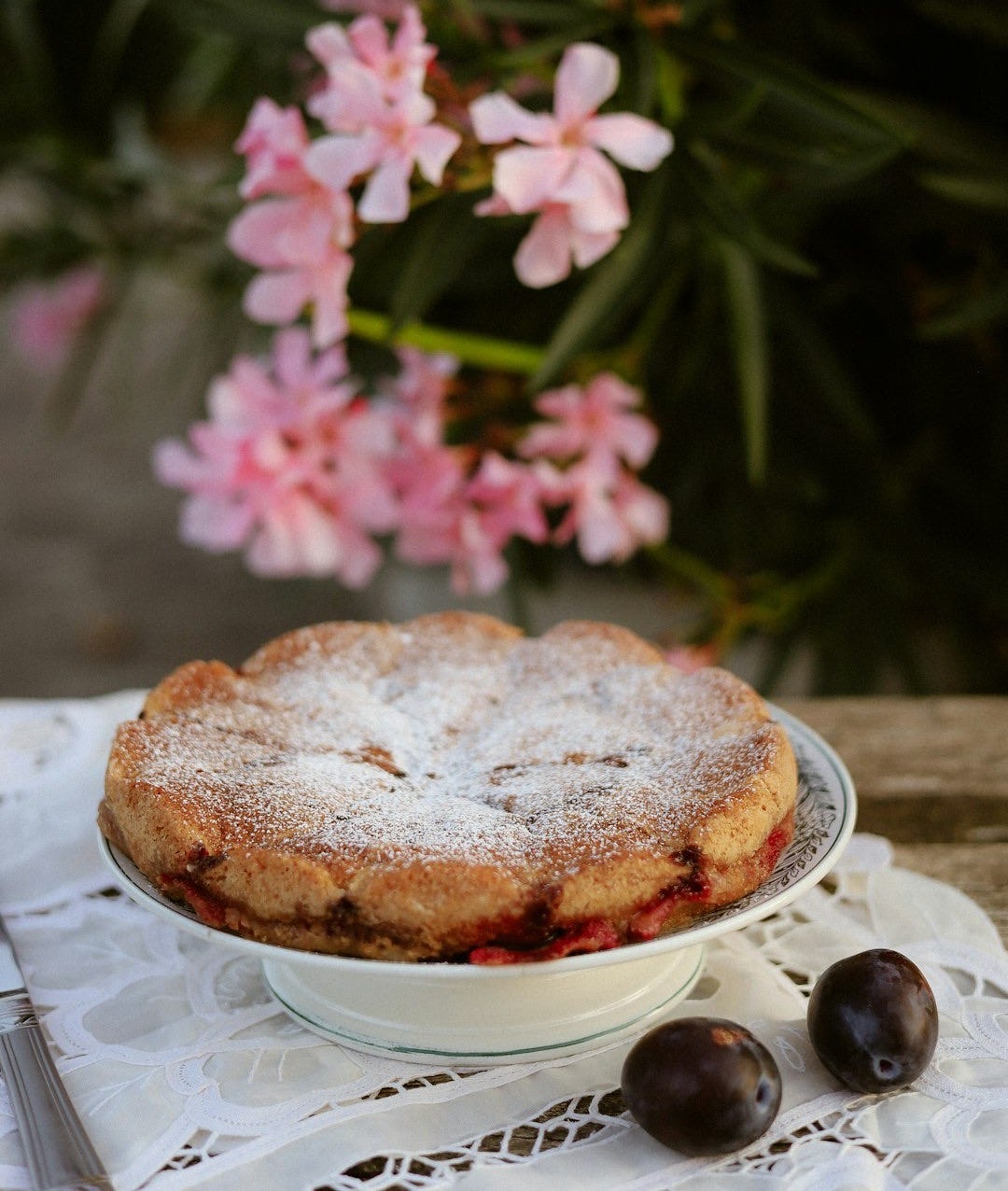
What if, like I did, on one August afternoon you stroll through your neighbourhood with your lover, with no plans other than to play outside your homes? The air is warm with a silky breeze. A cocktail of lavender, rose and jasmine spills over front lawns and follows you for a while. You pass a community garden rigged with a thicket of thorns that puncture the day with a hazy glow that sticks to your eyes for a long time. Wandering right, off the speed-bumped path, on the rear of a side wall, a familiar fruit dangles like ornaments on a Christmas tree. Could Google Street View have known this delight was here? I doubt it; the 360-view camera probably passed by in May, during the soft pink bloom, long before the fruit formed on this mature plum tree. These squidgy unspoilt plums, excess from a neighbour’s backyard, can only be reached if you’re comfortably six feet tall. Your man (or woman) hoists you up to gather enough to make some jam. These are treasures from the wild, so encrusted in at least one of your pickings is a sliver rising from a slumber. A maggot and its spawn, caught in its sweet home. At the stove, you carve them out and discard the maggot-drilled plums beyond your current capacity for the wild. Sugar, water, cloves and star anise—all thrown into the pot, along with the remaining plums from your playful stroll through a random spot. Not long before it swells, condenses, and then cools, you slather your homemade jam on buttered toast or dollop it on buttermilk pancakes, and wash it down with a chilled elderflower spritz.
Plum jam, him, and me. Bringing home these plums from the wild nurtured the explorer in me.

Who knew plums could be found close to home, and far from a convenience store? I didn’t, until I started noticing trees in my borough bearing fruit like the ones I saw in suburban orchards outside of the crowded capital I once called home. Actually, it was a Beth pear tree that first caught my eye down a friend’s old road. I wondered if the supermarkets stocked this stocky, blushed kind.
I also recall that long before that afternoon stroll, I started shifting my attention to noticing, instead of longing to know. But this practice takes a lot of patience, which feels uneasy in a world where answers are available in an instant.
Ambiguity feels like an unsafe place to be. Not knowing, especially not knowing quickly, tests our trust that we will eventually come to know. Today, we’re gorillas gripping onto containers that hold a trove of truths. Broadcast news, we waddle towards. Search engines, we leap. And clips circulating on socials—a rampage, but one that leaves us sometimes amused, and many times bemused, questioning their truth. Answers you never seek, seek to forever find you. And when we go looking, we skim through passages of best-selling self-help books. We treadmill through podcasts telling us what to do, feel and believe.
But, wouldn’t it be a blast to meander through paths, uncovering truths, happening across the sweetest one for you?

Tesco plums are picked while they’ve outgrown being a stone, though off the tree they feel like curved tourmaline with a pigment as deep as plum. You’ll wait long after they arrive from a South African or Chilean farm for them to plump and taste sweeter than tart. Then there are plums from a local tree with heaps gathered on the ground, begging for you to indulge in their sticky and sweet flesh. The dilemma: choosing between the one available all year round, or the other one, which waits for the late summer to appear and for you to cross its path. Nobody would willingly choose a tart plum tart.
The plums from my afternoon stroll are etched into my hands, my cornea, past my amygdala and into my soul. In another life, I would remember the candied plums that I picked from that tree and cradled to his stove.
Who to trust to carry offerings of fruit that provide more than an infusion of something sweet? Do we continue to rely on billion-dollar businesses to bring to us their best, when they have even less patience than the restless amongst us? A star in the sky, illuminating the tall grass crowding a path concealing swamps full of creatures we’ve never faced before, has become much too painful a path to pleasure.
But pleasure that stays a while comes after attending to the art of discovery. We can employ our senses like a bird navigating new territory. Can you imagine a crow typing ‘plums’ into a phone to source the cheapest or juiciest kind? And not an AI clip depicting this far-fetched scene. Out in the wild, or in the neighbourhood, the crow would work the land by instinct, returning to the same tree, season after season, guided by attention rather than convenience. We have that same capacity, though we’ve largely outsourced it. Without patience for discovery, a different kind of wildness moves in. The nervous system untended becomes its own uncharted, unnerving territory. Some reach for prescription drugs, and others for something illegal, searching for a way through without the journey. But there are other ways to expose the light. Perhaps a simple stroll. And if you’re lucky, plums you weren’t expecting to find will cross your path, settling something deeper than hunger.
I won’t deny that the fast track to answers has been fruitful. Still, not all fruit tastes like a pink sky at the end of a long afternoon hike. AI, TikTok, Google—they give while stealing our propensity to sense our way through. Our senses, tools we take for granted, can help us possess something more satisfying than a purchase. Will painting like Monet or buying a Monet let you know precisely which brush to use to create the clouds in an azure sky? It takes a ritualised form of attention lasting more than thirty seconds to sharpen the tools we use to guide us through life. And today, we need more than common sense to judge whether foraged plums are safe to take home — we need the practised attention we’ve cast aside. Simone Weil, a French philosopher, famously stated about attention, “it’s the rarest and purest form of generosity.” She insists it requires less willpower and more willingness to empty oneself, creating space for truth to arrive.
We separate ourselves from the unknown; tigers too wild to tame. But how can we be stewards of uncharted territories if we fail to know how to perceive what is just ahead? Your flashlight is dead, and your phone is lost, can you trust you’ll be able to make it back home?
Attention is not lost.
Once it roamed.
Today it’s been hijacked.
But we can get it back.
An afternoon stroll, where you happen to forage for some plums, alone or with a loved one, is the daring, yielding way to come to know.

Field Note:
Damson
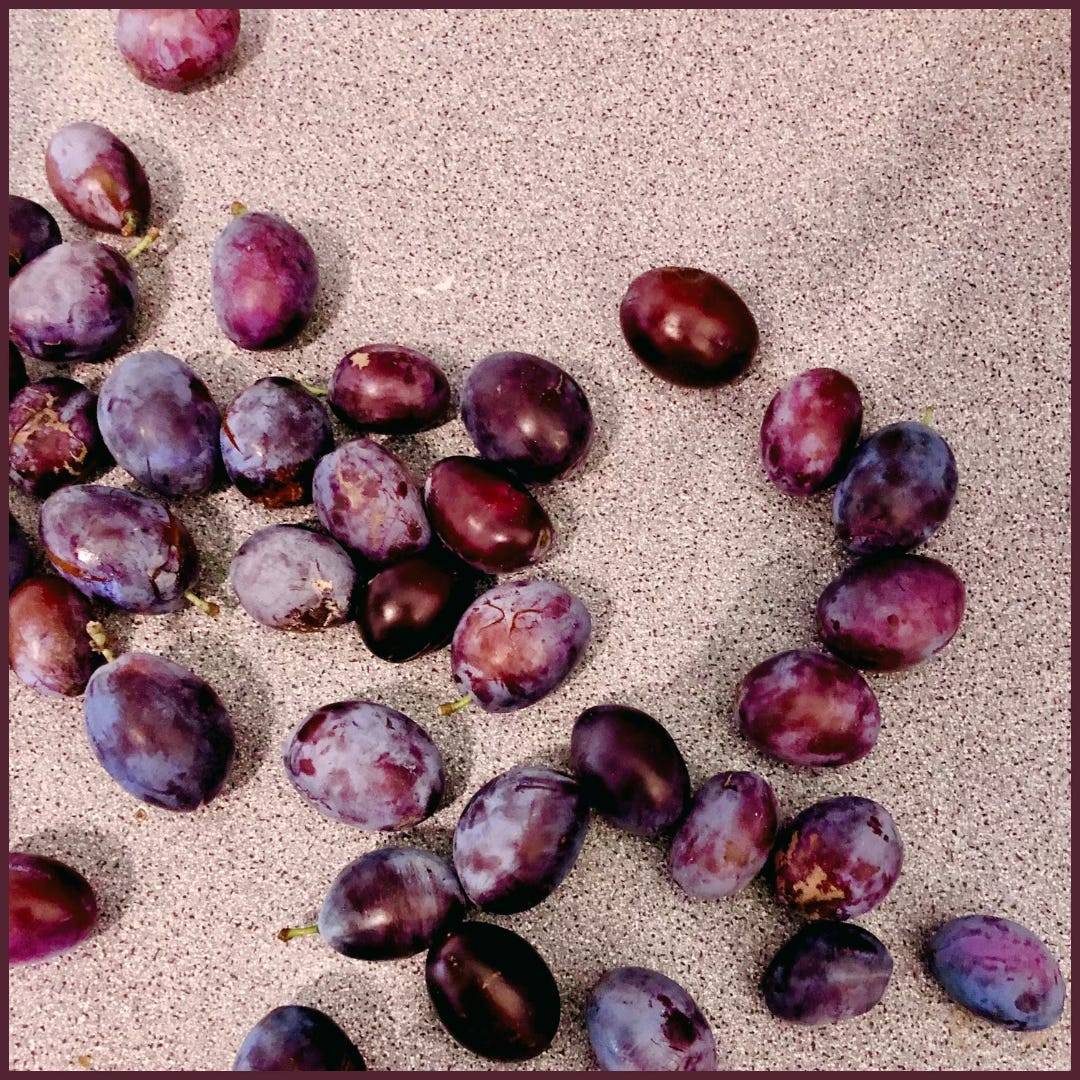
*This field note has been amended since this post was first published. I found the photos I took of the plums I picked on my walk, and they were damsons, not Pershore plums as previously stated.
Loved reading this Cheryl! Foraging and growing my own food has definitely changed my relationship with so much of what I eat and with 'convenience' in general.